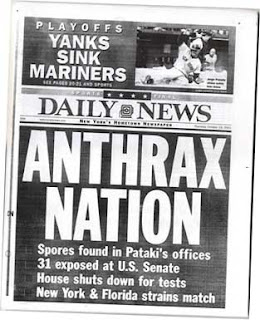
from mcclatchy: Buried in FBI laboratory reports about the anthrax mail attacks that killed five people in 2001 is data suggesting that a chemical may have been added to try to heighten the powder's potency, a move that some experts say exceeded the expertise of the presumed killer... The apparent failure of the FBI to pursue this avenue of investigation raises the ominous possibility that the killer is still on the loose. A McClatchy analysis of the records also shows that other key scientific questions were left unresolved and conflicting data wasn't sorted out when the FBI declared Ivins the killer shortly after his July 29, 2008, suicide... "America, the most advanced country in the world, and the FBI have every resource available to them," [Jacobsen] said. "And yet they have no compelling explanation for not properly analyzing the biggest forensic clue in the most important investigation the FBI labs had ever gotten in their history." As a result of Ivins' death and the unanswered scientific issues, Congress' investigative arm, the Government Accountability Office, is investigating the FBI's handling of the anthrax inquiry.
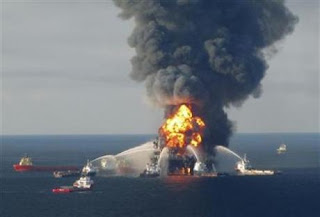
Some 780 million litres of crude oil - 4.9 million barrels - had poured onto the Gulf. The reddish-brown fluid lapped onto more than 1,000 kilometres of fragile coastline, killing thousands of fish, pelicans, tortoises, whales and dolphins. Officials closed beaches and fishing grounds. Tourism and the fishing industry, major keys to the local economy, collapsed.
Damage compensation payouts have been slow, despite the 20- billion-dollar fund that BP set up after some arm-twisting from US President Barack Obama. The Gulf Coast Claims Facility (GCCF) said this week it has paid out 3.8 billion dollars - a small drop of available money - representing 300,000 claims.
'huge price reduction' on unabomber's property! from cbsnews: The "one of a kind" western Montana property that was once owned by Unabomber Ted Kaczynski is back on the market for a bargain price of $69,500. The 1.4-acre parcel of land is listed by John Pistelak Realty of Lincoln and offers potential buyers a chance to own a piece of "infamous U.S. history." The listing also states that the forested land "is obviously very secluded." The Lincoln-area property, which had been listed at $154,500, does not have electricity or running water. Kaczynski was critical of technology. The property does not include the cabin where Kaczynski was captured in April 1996. It is on display in the Newseum in Washington, D.C. Kaczynski is in a maximum security prison in Colorado serving a life sentence after pleading guilty in 1998 to a nationwide bombing spree that spanned nearly 17 years and killed three people and injured 23 others. The Harvard-trained mathematician railed against the effects of advanced technology and led authorities on the nation's longest and costliest manhunt before his brother tipped off law enforcement in 1996.
cern atom-smasher relaunch delayed to september from afp: Researchers announced Monday a new delay for the restart of Europe's Big Bang atom-smasher, saying the faulty multi-billion dollar machine would now be turned back on in late September. The European Organisation for Nuclear Research (CERN) had planned to relaunch the Large Hadron Collider (LHC) this spring before delaying it to the summer. But CERN management decided to aim for a September restart to reinforce protection systems. "The schedule we have now is without a doubt the best for the LHC and for the physicists waiting for data," CERN Director General Rolf-Dieter Heuer said in a statement. "It is cautious, ensuring that all the necessary work is done on the LHC before we start-up, yet it allows physics research to begin this year."
who'll be the next darpa chief? from danger room: Tony Tether, the long-time chief of Darpa, is stepping down. So who'll be the next to head up the Pentagon's premiere research agency - and become the country's most visible defense geek? Several different names keep coming up. In no particular order, they include:
Dr. Lisa Porter, physicist, head of the Intelligence Advanced Research Projects Activity ("Darpa for spies"), and former NASA associate administrator;
Dr. Mark Lewis, aeronautical engineer, University of Maryland professor, and former Chief Scientist of the Air Force;
Dr. Michael Goldblatt, CEO of Functional Genetics, former head of Darpa's Defense Sciences Office, former science and technology chief at McDonald's Corporation;
Dr. Jane "Xan" Alexander, physicist, former deputy director of Darpa and the Homeland Security Advanced Research Projects Agency;
Dr. Regina Dugan, mechanical engineer, former Darpa program manager;
Zach Lemnios, electrical engineer, Chief Technology Officer at MIT's Lincoln Lab, and former director of Darpa's Microsystems Technology Office;
Dr. Amy Alving, aerospace engineer, Chief Technology Officer at SAIC, and former director of Darpa's Special Projects Office.
boeing says spysat-spying spysats on track for launch from register: US aerospace colossus Boeing says it has conducted successful ground testing of America's planned "space surveillance" satellite system. The idea, essentially, is spy satellites to spy on other spy satellites. Boeing and the US Air Force refer to the new watcher-watcher kit as Space Based Space Surveillance (SBSS). "The SBSS team is making good progress on the path toward launch," said Colonel James Jordan of the USAF Space Superiority Wing in Los Angeles. The colonel was speaking of recent tests in which a space-command ops centre in Colorado successfully sent control signals over "the encrypted Air Force satellite control network" to an SBSS spacecraft on the ground. The plan is for the first SBSS sats to be launched this spring. Once in space they will be able to monitor other objects in near-Earth space using optical sensors. America would like to be able to do this primarily because keeping track of opposition spy satellites is difficult from the Earth's surface... SBSS watcher-sats high in space can monitor a large part of an entire hemisphere, unaffected by weather. Not only can they keep tabs on opposition spybirds as they orbit, they can also watch what happens after things are launched into space. "The importance of a space-based capability to monitor space assets cannot be overstated," said Craig Cooning, Boeing veep in charge of space monitoring stuff. Well, maybe it can be just a little.
amerithrax lab halts research after toxin-tracking scare from danger room: When the Pentagon needs to handle the deadliest biowarfare threats, it turns to the labs of the U.S. Army Medical Research Institute of Infectious Diseases (USAMRIID) in Maryland. It's the only place in the American military complex equipped to handle the worst of the worst diseases -- those that have no cure and are transmissible by air. Which makes it extremely unnerving, that the place had to suspend biodefense research on Friday, "after discovering apparent problems with the system of accounting for high-risk microbes and biomaterials." That's the scoop from the new ScienceInsider blog, which notes that "the lab has been under intense scrutiny since August, when the Federal Bureau of Investigation named former USAMRIID researcher Bruce Ivins as the perpetrator of the 2001 anthrax letter attacks." The concern this time is that the lab may not be accurately tracking the use and storage of all of its biological organisms in an internal government database - leaving the door open to misplacement, mishandling, or worse. According to an internal memo obtained by ScienceInsider, "any materials found without a corresponding record in the database must be reported to the Vice Chief of Staff of the Army." "I believe that the probability that there are additional vials of BSAT [biological select agents and toxins] not captured in our … database is high," institute commander Col. John Skvorak wrote. This is not a good thing.
nerve agent may be missing from utah depot from deseret news: Is the Army missing some nerve gas? Pentagon auditors concede that is a remote possibility because of discrepancies in records between how much chemical weapons agent was initially stored and how much of it was later destroyed at Utah's Deseret Chemical Depot and other bases nationwide. But officials believe all the nerve agent in question was destroyed, according to a partially censored U.S. Army Audit Agency report obtained through a Freedom of Information Act request. Auditors list in it several reasons that could have caused apparent-but-unreal variances in those records. But auditors concluded, "The (Army Chemical Materials) Agency didn't have complete assurance that amounts recorded in the system were accurate, which increased its chances for heightened levels of program scrutiny by federal, state and international organizations that have a vested interest in the elimination of chemical weapons." Such words can cause shivers among Utahns who remember such things as the death of thousands of sheep in Skull Valley in 1968 that were blamed on nerve gas tests that went awry at nearby Dugway Proving Ground, and Skull Valley residents who have blamed mysterious illnesses on exposure to tiny amounts of nerve agent from such tests.
darpa wants sim to 'resurrect' battlefield trauma from danger room: Far-off commanders can already watch battles unfold, thanks to spy drones, streaming video overhead. They can read after-action reports, to learn how troops on the ground experienced the fight. But those officers don't have detailed, digitally-animated simulations, merging all that info - and showing how similar fights might go, in the future. Which is a situation Darpa, the Pentagon's blue-sky research arm, would like to fix. The agency is holding a mid-December meeting in Virginia to launch its "RESURRECT" (REstoring SURvivability by REConstructing Trauma) project. It aims to "create high-fidelity computer simulations" of warzone events "for tactical, operational and strategic review."
fighting with photons: the most famous weapon of science fiction is rapidly becoming fact from economist: Like so much else in science fiction, the ray gun was invented by H.G. Wells. In the tentacles of Wells’s Martians it was a weapon as unanswerable by earthlings as the Maxim gun in the hands of British troops was unanswerable by Africans. Science fiction, though, it has remained. Neither hand-held pistols nor giant, orbiting anti-missile versions of the weapon have worked. But that is about to change. The first serious battlefield ray gun is now being deployed. And the next generation, now in the laboratory, is coming soon. The deployed ray gun (or “directed-energy weapon”, in the tedious jargon that military men seem compelled to use to describe technology) is known as Zeus. It is not designed to kill. Rather, its purpose is to allow you to remain at a safe distance when you detonate unexploded ordnance, such as the homemade roadside bombs that plague foreign troops in Iraq... The Missile Defence Agency releases a fact sheet about its Airborne Laser. Raytheon has a video and a press release about LADS.
eads north america's tentainer(tm) mobile shelter from marketwatch: A compact and highly deployable mobile shelter for military medical support missions, emergency response and disaster relief will be unveiled by EADS North America at this month's Association of Military Surgeons of the United States (AMSUS) annual meeting in San Antonio, Texas, beginning Monday, Nov. 10. The new unit, called Tentainer, is a hybrid shelter that combines a rigid-walled, lightweight lower container with a multi-cell inflatable tent upper portion. Built by EADS North America Integrated Shelter Systems in Russellville, Ark., Tentainer is tailored for applications such as military forward surgical stations, trauma treatment facilities, first aid stations and mobile command posts.
kuwaiti navy, nato conclude military drills in gulf from rtt news: Kuwaiti Navy and ships from the Standing NATO Maritime Group 2 (SNMG2) concluded strategic military exercises Sunday, the first of their kind in the Gulf region. The joint exercises were part of the Istanbul Cooperation Initiative (ICI) and a security agreement with the NATO on information exchange. The six-day drills included fast inshore attack training, anti-piracy demonstration, an air defense exercise, and a demonstration of firepower.
test drill at miami international airport aims to slow pandemics from miami herald: About 400 people participated in the nation's first pandemic flu exercise at Miami International Airport. What if a deadly global pandemic were sweeping across the world and the United States needed to try to delay its effect on our shores? For the first time, at Miami International Airport on Wednesday [nov5], about a dozen federal, state and local agencies participated in a simulation exercise to review the steps needed to screen international passengers arriving in the face of a severe influenza pandemic. "It's an opportunity to test the plan, see how it works and what needs to be improved, so that when we need to use it for real we are ready," said Christine Pearson, spokeswoman for the Centers for Disease Control and Prevention in Atlanta. About 400 people participated in the test drill, including about 200 voluntary actors. CDC, the Department of Homeland Security and the Department of Transportation led the effort... "A pandemic is inevitable, but we can't say it's imminent," said Dr. Martin Cetron, director of global migration and quarantine for the CDC.
navy intercepts ballistic missile target in fleet exercise from spacewar: Vice Adm. Samuel J. Locklear, Commander, U.S. Third Fleet has announced the successful Navy intercept of a ballistic missile target over the Pacific Ocean during Fleet Exercise Pacific Blitz. This was the first Fleet operational firing to employ the Standard Missile-3 (SM-3) against a ballistic missile target. Command and control of this mission resided with Commander, U.S. Third Fleet, based in San Diego, Calif... "The successful engagement of ballistic missile targets from ships at sea is extraordinary... Pacific Blitz highlights the successful transition from developmental test flights to operational fleet execution and demonstrates the viability of the Maritime BMD Concept of Operations."
nato voices serious worries about russian missile plans from afp: NATO has "serious worries" about the compatibility of Russian plans to deploy missiles in a western Russian enclave with arm control "arrangements," an alliance spokesman said Wednesday. "We have seen the press reports on the statement of President (Dmitry) Medvedev regarding deployment of Iskander missiles to the Kaliningrad region," spokesman Robert Pszczel told AFP. "If confirmed, it would raise serious worries concerning the conformity with existing arms control arrangements which are important for European security," he added.
venezuela & russia discuss nuclear energy & flights from ap: Top Venezuelan and Russian officials met Thursday to discuss bilateral agreements on everything from nuclear energy to direct flights connecting Caracas to Moscow. Russian Deputy Prime Minister Igor Sechin headed a delegation of business leaders visiting Venezuela to discuss development plans prior to Russian President Dimitri Medvedev's visit later this month. "In a moment when the banks of the developing world are going bankrupt and disappearing, our two countries are negotiating the creation of a binational bank that will allow the financing of development," Venezuelan Vice President Ramon Carrizalez said.
china's space industry takes off from spacedaily: China put another two satellites into orbit on Wednesday, just weeks after its third successful manned space mission and the first space walk by Chinese astronauts in September. The space industry is taking off, thanks to the 30-year-old Reform and Opening-up Drive, said Zhou Jianping, chief designer of the manned space program. China established its space sector in the 1950s, an era of difficulty and hardship.
postal anthrax aftermath: has biodefense spending made us safer? from sciam: As the Federal Bureau of Investigation was about to move in, U.S. Army biodefense scientist Bruce Ivins committed suicide, thus possibly closing the chapter on the first—and so far only—fatal bioattack in U.S. history. The FBI alleges that Ivins, who worked at the U.S. Army Medical Research Institute of Infectious Diseases (USAMRIID) in Fort Detrick, Md., mailed anthrax-laden letters in September and October 2001 that killed five people. The incidents sparked a massive infusion of research funds to counter civilian bioterrorism, $41 billion spread over seven federal departments and agencies. Yet some observers argue that those funds have done little to guard against another bioterror incident, especially if the FBI is right about Ivins.
huge new biodefense lab is dedicated at ft detrick from washington post: The Department of Homeland Security dedicated a massive biodefense laboratory in Frederick yesterday, moving toward the facility's opening despite questions raised about the risks of deadly pathogens to be studied there. When the National Biodefense Analysis and Countermeasures Center at Fort Detrick is fully operational in March, about 150 scientists in the lab will be tasked with protecting the country from a bioterrorist attack through prevention or containment. Another goal is to allow investigators to fingerprint biological agents such as viruses and bacteria, quickly tracing their source and catching the offender. But critics cite the case of Bruce E. Ivins, a researcher at the U.S. Army Medical Research Institute of Infectious Diseases, also at Fort Detrick, as evidence that such installations might help bioterrorists get access to lethal agents. FBI investigators think Ivins, who committed suicide in July, was responsible for the 2001 anthrax attacks.
fda conspired with chem industry to declare bpa harmless from natural news: The FDA has been caught red-handed conspiring with the chemical industry to conclude that Bisphenol-A, the plastics chemical, is harmless to human health. As revealed by the Environmental Working Group, the FDA based its evaluation of BPA on a report authored by the American Chemistry Council (ACC), a trade group that represents chemical companies and plastics manufacturers. The FDA's evaluation concluded that BPA was perfectly safe for consumers of any age, including infants. This conclusion stands in direct opposition to the Canadian government, which declared BPA to be a toxic chemical on Oct. 18 and moved towards banning the chemical in baby bottles. Even the U.S. National Institutes of Health says BPA may be dangerous, admitting it is concerned about BPA's "effects on development of the prostate gland and brain and for behavioral effects in fetuses, infants and children."
gates funds research into 'flying syringe' mosquitos for 'vaccines' from afp: The Bill and Melinda Gates Foundation awarded 100,000 dollars each on Wednesday to scientists in 22 countries including funding for a Japanese proposal to turn mosquitos into "flying syringes" delivering vaccines. The charitable foundation created by the founder of software giant Microsoft said in a statement that the grants were designed to "explore bold and largely unproven ways to improve global health."
single-bullet specter want details of anthrax investigation from iht: A month after the FBI declared that a U.S. Army scientist was the anthrax killer of 2001, leading members of Congress are demanding more information about the seven-year investigation, saying they do not think that the bureau has proved its case.
In a letter sent Friday to Robert Mueller 3rd, director of the Federal Bureau of Investigation, Democratic leaders of the House Judiciary Committee said that "important and lingering questions remain that are crucial for you to address, especially since there will never be a trial to examine the facts of the case."
The scientist, Bruce Ivins, committed suicide in July, and Mueller is likely to face demands for additional answers about the anthrax case when he appears before the House and Senate Judiciary Committees on Sept. 16 and 17.
"My conclusion at this point is that it's very much an open matter," Senator Arlen Specter of Pennsylvania, the top Republican on the Senate committee, said of the strength of the case against Ivins, a microbiologist at the army's biodefense laboratory who worked on anthrax vaccines. "There are some very serious questions that have yet to be answered and need to be made public."
anthrax case to be reviewed by panel from washington times: FBI Director Robert S. Mueller III told lawmakers Tuesday that an independent panel will review the science that the bureau relied on to conclude a troubled Army microbiologist carried out the 2001 anthrax attacks. "We're in discussions with and are going to request the National Academy of Sciences review the work that was done in the course of this investigation," Mr. Mueller testified before the House Judiciary Committee. "But as I say, the national academy is an independent entity and will be conducting a review."
the fbi's mail-sorting theory doesn't add up from george washington: The FBI claims that mail-sorting equipment crushed the killer anthrax in the letters to Senators Daschle and Leahy down to a fine powder. Is that possible? Well, the anthrax spores in the Daschle letter were 1.5 to 3 microns, according to the Washington Post. See also (this). There are 25,400 microns in an inch. Mail-sorting equipment is generally built to handle letters at least 1/4 inch thick. Correspondingly, U.S. Postal Service guidelines allow letters to be up to 1/4 of an inch thick.
Here is one of the U.S. Postal Service's mail sorting machines which actually processed an anthrax letter in 2001 (although probably not the one which processed the Leahy and Daschle letters): What does this all mean? 1/4 of an inch equals 6,350 microns. So the FBI is trying to say that a mail-sorting machine which is designed to process letters 6,350 microns thick crushed something down to 3 microns . . . 2,116 times smaller than the type of envelope sorting machines are designed to handle. I don't know about you, but my mail isn't crushed into oblivion when I get it.
On the other hand, the LA Times hints at a more likely explanation: "Since the early 1990s, U.S. Army scientists at Dugway Proving Ground in Utah have made small quantities of weapons-grade anthrax that is virtually identical to the powdery spores used in the bioterrorist attacks that have killed five people, government sources say."
scientist concedes 'honest mistake' about weaponized anthrax from latimes: An acclaimed government scientist who assisted the federal investigation of the 2001 anthrax mailings said Tuesday that he erred seven years ago when he told top Bush administration officials that material he examined probably had been altered to make it more deadly. The scientist, Peter B. Jahrling, had observed anthrax spores with the aid of an electron microscope at the government's biological warfare research facility at Ft. Detrick, Md... "I believe I made an honest mistake," Jahrling said in response to questions e-mailed to him for this article, adding that he had been "overly impressed" by what he thought he saw under the microscope. "I should never have ventured into this area,"
leahy: others involved in anthrax attacks from abc: Senate Judiciary Committee chairman Sen. Patrick Leahy told FBI Director Robert Mueller during testimony before his committee that he did not believe Army scientist Bruce Ivins acted alone in the 2001 anthrax attacks. "I believe there are others involved, either as accessories before or accessories after the fact," said the Vermont Democrat who received an anthrax-tainted letter. "I believe that there are others out there. I believe there are others who could be charged with murder."
anthrax-case affidavits add to bizarre portrait of suspect from nytimes: A judge unsealed a new batch of court documents in the anthrax case on Wednesday, filling in further details of the bizarre behavior of Bruce E. Ivins, the Army scientist who the F.B.I. has said carried out the letter attacks of 2001. Last September, according to a sworn statement from an F.B.I. agent, Dr. Ivins sent himself an exuberant e-mail message under the heading “Finally! I know Who mailed the anthrax!” He did not identify the perpetrator but said he was close to assembling the final proof. “I’m not looking forward to everybody getting dragged through the mud, but at least it will all be over,” Dr. Ivins wrote, adding, “I should have been a private eye!!!!” and signing the message “Bruce.”
ivins bragged to himself in an email that he knew anthrax killer from raw replay: Bruce Ivins, the Army scientist accused of carrying out the 2001 anthrax attacks, e-mailed himself last yearsaying he knew who the killer was. According to an FBI affidavit, the e-mail was dated Sept. 2007. This video is from The Associated Press, broadcast September 25, 2008.
anthrax case stays open: why did the fbi let the ft detrick scientists investigate themselves? from truthout: The Congressional anthrax hearings of September 16-17 revealed that public pressure is keeping the doors open in the anthrax case. FBI Director Robert Mueller promised that the FBI will provide their evidence to a panel of experts for scientific evaluation. The battle will now turn to the independence of this panel, and whether "all evidence" or merely "scientific evidence" will be under review.
During the hearings, Mueller found himself under fire by Senator Patrick Leahy and Congressman John Conyers for not having answers to their questions. Republican Arlen Specter was furious at Mueller for his unwillingness to assure them that Congress would have a role in determining the panel's composition.
Meanwhile, new evidence shows just how deeply wrong ABC and Washington Post reporters have been over the years on their coverage of the anthrax attacks. They can't have it both ways: Either they made repeated "mistakes" by relying on their sources, or several people deliberately lied in order to advance war on Iraq.
In his recent book Taking Heat, former White House secretary Ari Fleischer wrote that Bush was more shook up by the anthrax attacks than by any other event. White House officials repeatedly pressed Mueller to prove it was a second-wave assault by al-Qaeda or Iraq. After days of provocative statements designed to scare the American people, Cheney himself believed that he had been exposed to anthrax. Although the test results were negative, October 18, 2001, was the moment when Cheney decided to withdraw to an "undisclosed location" and carry biodefense protection during all of his mysterious travels.
fbi won’t release documents on anthrax suspect from freep: The FBI is declining to release at least 15,000 pages of documents related to the now-deceased prime suspect in the 2001 anthrax attacks despite lingering suspicions that the bureau has accused the wrong man.
In August, the FBI and Justice Department identified Bruce Ivins, a former microbiologist at the U.S. Army’s biological weapons research center at Ft. Detrick, Md., as the “only person involved” in the attacks that killed five people.
But David Hardy, the section chief of the FBI’s records management division, notified McClatchy Newspapers that his office couldn’t immediately release the records because there were “investigative leads still open” and the FBI needed to withhold the documents to protect confidential sources, privacy, law enforcement techniques and a suspect’s right to a fair trial.
McClatchy had filed a request for the documents under the federal Freedom of Information Act, which generally permits the release of records of a dead person. Ivins committed suicide in July.
mailmen may deliver anti-anthrax drugs from washington times: If there ever is another anthrax attack, the letter carrier may deliver your antibiotics. Federal health officials are beginning a project in Minneapolis-St. Paul to let letter carriers stockpile a personal supply of emergency antibiotics so they are protected and ready to deliver aid to the rest of the city at a moment's notice.
"These letter carriers are being asked to put their lives on the line to help their communities," Health and Human Services Secretary Michael Leavitt said Wednesday. By ensuring they are protected first, "the carriers can be ready on short notice to take to the streets."
The project aims to overcome a big hurdle of emergency planning. The government has much drugs stockpiled in case of future bioterrorism, but few ways to get them quickly to panicked citizens. Leavitt noted that if someone possibly has inhaled anthrax, the chances of survival are best if antibiotic treatment begins within 48 hours.
fair use notice: this site contains copyrighted material the use of which has not always been specifically authorized by the copyright owner. we are making such material available in our efforts to advance understanding of environmental, political, human rights, economic, democracy, scientific, & social justice issues, etc. we believe this constitutes a 'fair use' of any such copyrighted material as provided for in section 107 of the US copyright law. In accordance with title 17 usc section 107, the material on this site is distributed without profit to those who have expressed a prior interest in receiving the included information for research and educational purposes.

 strong quake hits off coast, no damage*