bills would kill dhs satellite surveillance office from fcw: A senior House Democrat has introduced legislation that would kill the controversial National Applications Office (NAO), a Homeland Security Department-run program to make intelligence and military satellite imagery available to civilian agencies for domestic purposes. Rep. Jane Harman (D-Calif.), chairwoman of the Homeland Security Committee’s Intelligence, Information Sharing and Terrorism Risk Assessment Subcommittee, introduced a bill on June 4 that would require DHS to immediately close the NAO. She also introduced a measure, co-sponsored by Rep. Norman Dicks (D-Wash.), to prohibit DHS from spending any money on the NAO or any similar program.
the internet 'absolutely' will become a 'paid system' within 5yrs from zdnet: The days of the free Internet will draw to a close over the next five years, according to the chairman and chief executive of IAC, the interactive services company which operates a collection of more than 30 Internet sites which produce $1.5 billion a year in revenue. The only missing link, according to Barry Diller, who cut his teeth building up over-the-air and cable TV networks: a good billing system, akin to Amazon’s “one-click” button or the Apple iPhone’s slick downloading of paid applications. "I absolutely believe the Internet is passing from its free days into a paid system. Inevitably, I promise you, it will be paid," Diller said in a keynote discussion opening up the Advertising 2.0 conference held at his company’s futuristic glass building alongside the Hudson River in Manhattan. "Not every single thing, but anything of value."
contractors vie for plum work, hacking for US from nytimes: The government’s urgent push into cyberwarfare has set off a rush among the biggest military companies for billions of dollars in new defense contracts. The exotic nature of the work, coupled with the deep recession, is enabling the companies to attract top young talent that once would have gone to Silicon Valley. And the race to develop weapons that defend against, or initiate, computer attacks has given rise to thousands of “hacker soldiers” within the Pentagon who can blend the new capabilities into the nation’s war planning. Nearly all of the largest military companies — including Northrop Grumman, General Dynamics, Lockheed Martin and Raytheon — have major cyber contracts with the military and intelligence agencies. The companies have been moving quickly to lock up the relatively small number of experts with the training and creativity to block the attacks and design countermeasures. They have been buying smaller firms, financing academic research and running advertisements for “cyberninjas” at a time when other industries are shedding workers. The changes are manifesting themselves in highly classified laboratories, where computer geeks in their 20s like to joke that they are hackers with security clearances.
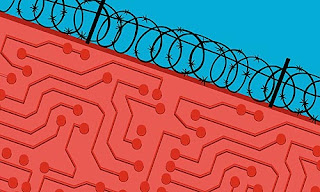
cybersecurity framework for total govt regulation & control from paul joseph watson & kurt nimmo: The Obama administration’s new Cybersecurity system will only make the Internet more vulnerable to attack, while creating the framework for a massively upgraded government surveillance grid that will control and regulate every aspect of our daily lives through the implementation of “smart” technology. Obama’s announcement of the new cybersecurity grid dovetails with a recently introduced Senate bill, the Cybersecurity Act of 2009, that would hand the president the power to shut down the entire Internet in the event of a “cybersecurity” crisis. The bill’s draft states that “the president may order a cybersecurity emergency and order the limitation or shutdown of Internet traffic” and would give the government ongoing access to “all relevant data concerning (critical infrastructure) networks without regard to any provision of law, regulation, rule, or policy restricting such access,” reports Raw Story. The legislation would allow the government to tap into any digital aspect of every citizen’s information without a warrant. Banking, business and medical records would be wide open to inspection, as well as personal instant message and e mail communications. This is President Bush’s warrantless wiretapping program on steroids, yet the reaction from the liberal left has been muted to say the least. Furthermore, the reasoning behind the proposal is a farce, since cybersecurity will make the Internet even more vulnerable to attack. According to Jennifer Granick, director of civil liberties at the Electronic Frontier Foundation, the program would “basically establish a path for the bad guys to skip down.” One of the bill’s authors, Democratic Sen. Jay Rockefeller of West Virginia, admitted that the bill was about more than just military or intelligence concerns. “It is a lot more than that. It suddenly gets into the realm of traffic lights and rail networks and water and electricity,” said Rockefeller.
fair use notice: this site contains copyrighted material the use of which has not always been specifically authorized by the copyright owner. we are making such material available in our efforts to advance understanding of environmental, political, human rights, economic, democracy, scientific, & social justice issues, etc. we believe this constitutes a 'fair use' of any such copyrighted material as provided for in section 107 of the US copyright law. In accordance with title 17 usc section 107, the material on this site is distributed without profit to those who have expressed a prior interest in receiving the included information for research and educational purposes.

 US swine flu cases now exceed 21,000; 87 deaths*
 epa declares 'emergency' asbestos cleanup in montana town*